
Do you have an empty sketchbook lying around?
Or do you have a sketchbook that you abandoned halfway through?
Either way, it’s time to learn how to fill a sketchbook so you can exercise your creative muscles and put that precious paper to good use.
There are many fun ways to fill a sketchbook that don’t require a big time investment or tons of art supplies.
So in this blog post, I’m showing you how to fill your sketchbook with easy drawing ideas. In it, you learn:
- Why drawing simple lines and basic shapes are great exercises to practice
- The benefits of creating colour swatches and colour blends
- How to draw repeating patterns using mixed media supplies
By the time you’re done reading, you’ll be able to fill your sketchbook with easy drawing ideas that are fun, playful, and which allow you to loosen up and embrace imperfection.
Table of Contents
1. Mark Making and Basic Shapes
Going back to basics is a smart way to practice your art skills and fill up your sketchbook.
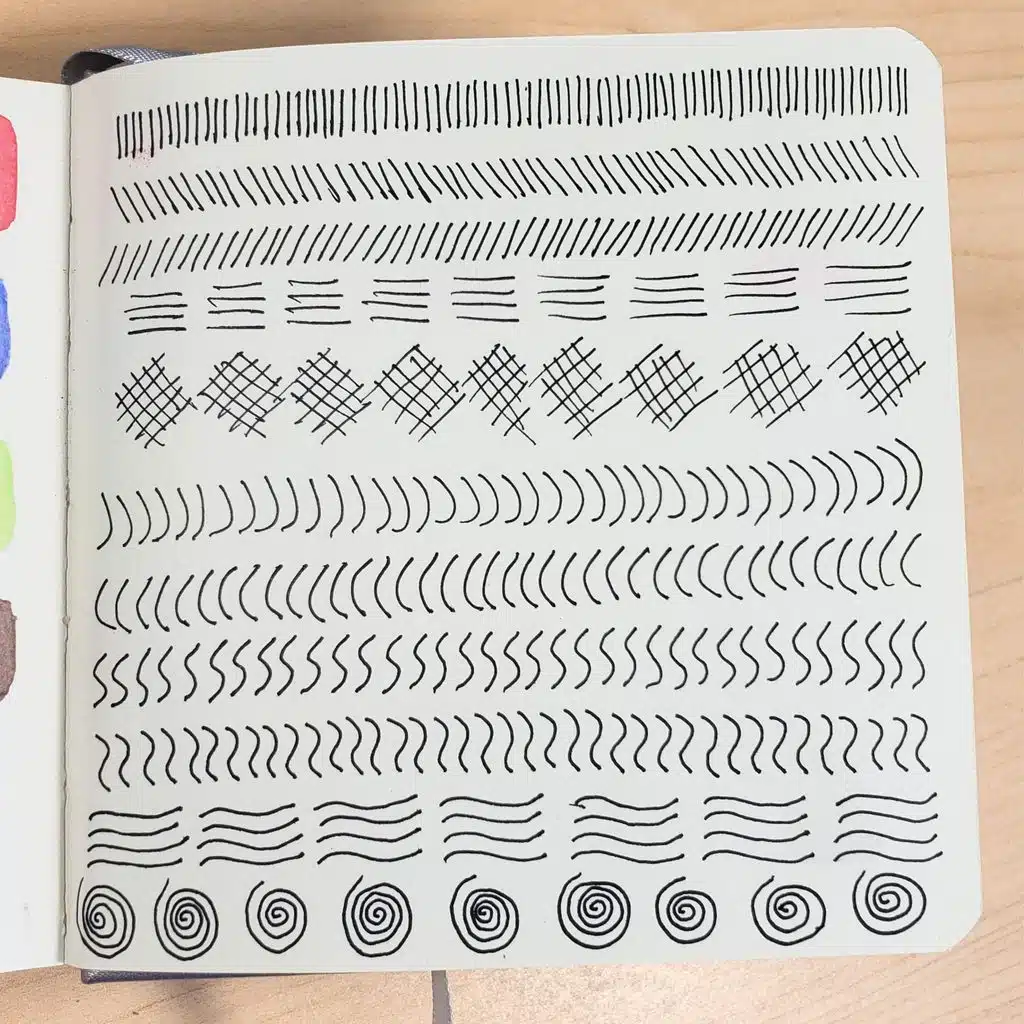
Therefore, one of the easiest ways to fill a sketchbook page is by making marks and drawing basic 2D shapes.
You can do this exercise with many mediums including graphite pencils, pen and ink, coloured pencils, alcohol markers, watercolour pencils, and so on.
All you have to do is pick your preferred art supply and then start making marks in your sketchbook. Here are some ideas to help you get started:
- Vertical, horizontal, and diagonal lines
- C curves, S curves, wavy lines, and spirals
- Crosshatching and stippling
- Circles, ovals, and rounded shapes such as hearts and clouds
- Squares, rectangles, triangles, and sharp shapes such as stars
Drawing these simple lines and shapes warms up your hand, allows you to practice various strokes, and encourages you to draw loosely and quickly.
2. Create Colour Swatches and Colour Blends
If you have a fear of the blank page, one of the best ways to overcome blank page anxiety is by creating a series of colour swatches.
Playing with colour is a relaxing activity that allows you to engage with your sketchbook, thus reducing unnecessary pressure and expectation.
For example, if you’re painting with watercolours, choose a limited colour palette and make swatches of those pigments. Then, blend two colours to observe how those pigments mix together.
After that, you can take it a step further and fill your sketchbook with simple watercolour warmups such as quick value studies.
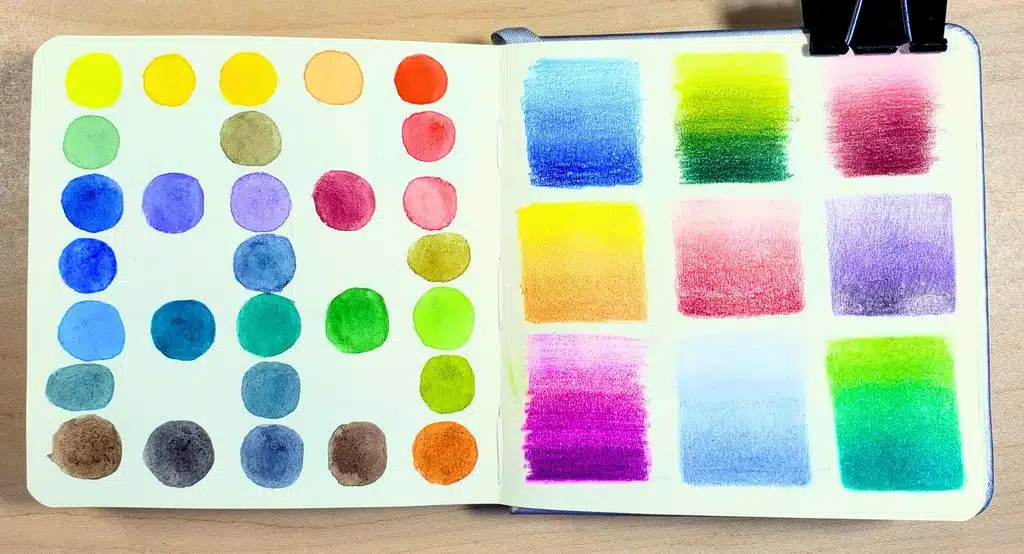
Or if you’re using coloured pencils, choose a limited colour palette—such as the 7 colours of the rainbow—and blend those colours together to create different combinations.
The point of this exercise isn’t to create a finished work of art.
The goal is to fill your sketchbook with simple colour swatches and blends that help you get to know your art supplies more intimately.
Note: If you’re using wet media such as pen and ink, alcohol markers, or watercolours, use this exercise to test the weight and durability of the sketchbook paper.
3. Draw Patterns With Mixed Media Supplies
If you don’t know how to fill a sketchbook, here’s a simple idea for you. Choose a pattern that appeals to you and draw that pattern over and over.
Personally, I like doing this exercise with mixed media supplies because playing with different mediums encourages you to think outside of the creative box.
The first step is to choose one art supply to create a colourful background.
The second step is to choose another supply to the draw pattern over the colourful background.
That’s it! It’s really that easy. Here are a few creative ideas to try in your sketchbook:
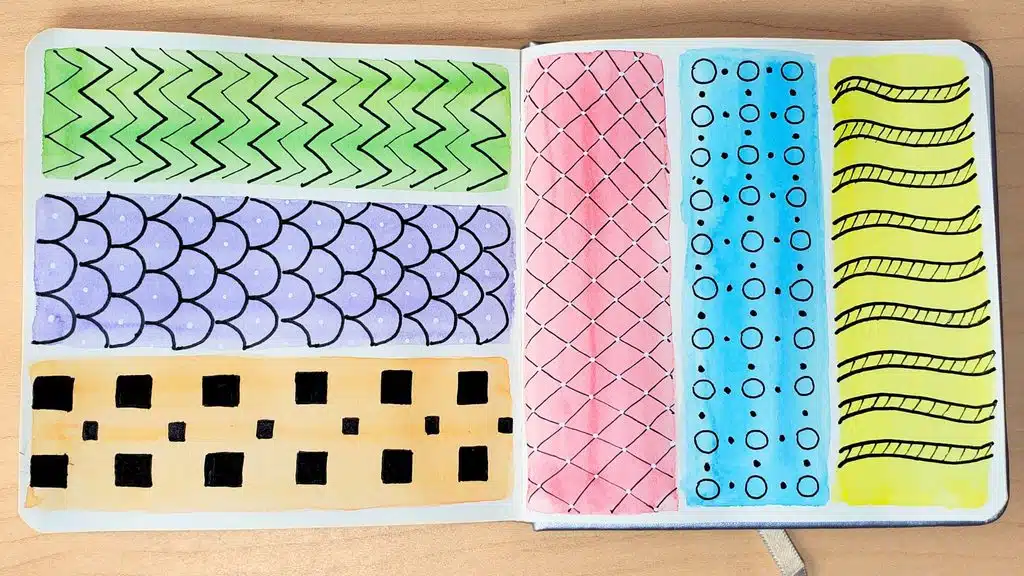
- Watercolour and Ink: Lay down a wash of watercolour and then use ink to doodle a pattern over it. This is what I did in the example above
- Alcohol Markers and Coloured Pencils: Lay down colour with an alcohol marker, then draw a pattern over it using a coloured pencil
- Layer Light Over Dark: Lay down a dark colour and draw a pattern over it with a white gel pen
- Layer Dark Over Light: Lay down a light colour and draw a pattern over it with black ink
Note: Don’t worry about making your patterns look straight, equally spaced, or perfectly aligned. The goal of this exercise is to have fun making marks and patterns to build muscle memory in your hand.
Bonus: Simplify Your Creative Routine
If you’ve been procrastinating to use your sketchbook, or you struggle to make time for art, the best way to reduce resistance is to simplify your art routine.
The benefit of simplifying your creative routine is that doing so minimizes decision fatigue and maximizes creative exploration.
So here are a few practical strategies to help you tweak your creative routine to make it feel less stressful and more approachable:
- If your sketchbook is too big, buy a small sketchbook because you can fill a page more easily and quickly
- If you have too many art supplies, choose 1 medium to work with
- If you’re overwhelmed by too many colours, use a limited colour palette
- If you have too many creative ideas, brainstorm 1 – 2 subjects in advance
- If you struggle with perfectionism, focus on practice and progress
Conclusion
Remember this: Sketchbooks are safe spaces for creative exploration and experimentation.
That means these easy art exercises and doodles have just as much value as finished pieces.
Learning how to fill a sketchbook isn’t just about what you draw or paint in your sketchbook. Equally important is learning how to prepare before you start creating art.
Now that you know how to fill a sketchbook with 3 easy exercises and 1 mindset shift, it’s time for you to take action!
If you’re ready to take your sketchbook one step further, check out the fun YouTube video below where I share real drawings and sketches from my own sketchbooks!
Miranda Balogh
Artist & Online Educator
The warm-up shapes and repeating-pattern exercise could connect nicely on the same page: turn one circle or curve into three tiny motif options, then repeat only the one you want to explore. A brief note recording the supplies and layer order would let the page double as a reference without making the spacing or edges perfect.