
Nowadays, people are increasingly becoming more health conscious.
Even when it comes to art supplies, artists like you want to make sure your products are safe and harmless.
And so you wonder, “Is watercolour paint toxic?”
As a whole, most watercolour paints are mildly toxic but they don’t contain enough chemical compounds to harm the human body. However, certain pigments are known to be more toxic and problematic than others. For this reason, you should always check your pigment’s toxicity rating.
So, let’s take a look at the best practices that will ensure that you watercolour painting experience is as safe and non-toxic as possible.
Table of Contents
Is Watercolour Paint Safe?
Some artistic mediums such as oil painting are known for possessing paint pigments that can be toxic and harmful to the body.
So, naturally, many watercolourists wonder if the same is true of watercolour paints.
Fortunately, the majority of watercolour paints are safe to use on a regular basis because they either do not contain harmful or toxic chemicals, or they don’t contain toxic compounds in any significant quantity that could harm your body.
Hurray for the good news! The myth that watercolour paint is not safe has been debunked!
Related: Check out this popular article if you want to learn about false watercolour myths.
That being said, you should be aware of which watercolours are toxic and non-toxic.
For example, pigments such as cobalt, nickel, and cadmium (which is found in yellows, oranges, and reds) contain a greater quantity of hazardous chemical compounds.
But unless you are unfortunate enough to eat or digest a very large quantity of these chemical compounds, these pigments are not going to damage your body when you paint with them.

How Do You Check Watercolour Toxicity Ratings?
To check a paint’s toxicity rating, you need to identify a non-toxic symbol that certifies the paint’s non-toxic composition. This symbol lets you know that the pigment is safe to use.
If you cannot find this information on the package in which you bought your paints, you can easily find the information on the manufacturer’s website.
For instance, if you want to know if your Winsor & Newton watercolour is toxic, you can head over to their website to check out the Winsor & Newton health and safety information for details.
Or you can look up your specific paint palette to see if you can find a specific toxicology information for that set.
Note: If you’d like to see an example, I’ve included a link to Winsor & Newton’s Cotman Watercolours 12 Tube Set. When you scroll down the page, you’ll see a link to download the Safety Data Sheet. Check it out to see what kind of toxic substances may be used in the paints.

How to Reduce Exposure to Watercolour Paint Toxicity?
Even though most watercolour paints are non-toxic and perfectly safe for regular use, you might want to take extra precautions to reduce your exposure to toxic chemicals.
As a result, I’ve brainstormed a list of watercolour hacks and best practices that’ll help you paint as safely and healthily as possible:
- Don’t eat food or drink beverages while you’re painting. You don’t want to accidentally consume any paint pigments
- Never lick your watercolour brushes, not even to smooth the bristles back to a fine point
- Wash your hands immediately after you’ve finished painting
- Wear gloves while painting if you’re worried about toxic exposure on your hands
- Rinse your brushes off and refill the jars often to reduce your exposure to dirty water and chemicals
- If you use a plate as a mixing palette, only use that plate for watercolour painting and never use it for cooking. The same logic applies to your water jars and cups
- If you’re clumsy or prone to messiness, wear a shirt and a pair of pants that you don’t mind dirtying. When you’re done painting, throw the clothes in the laundry
- If a specific paint is too toxic for your liking, find a dupe that is similar hue but which is less toxic
- When purchasing new paints, opt for paints that contain fewer pigments. Paints with fewer pigments are purer and less likely to contain as many heavy metals and other chemical compounds
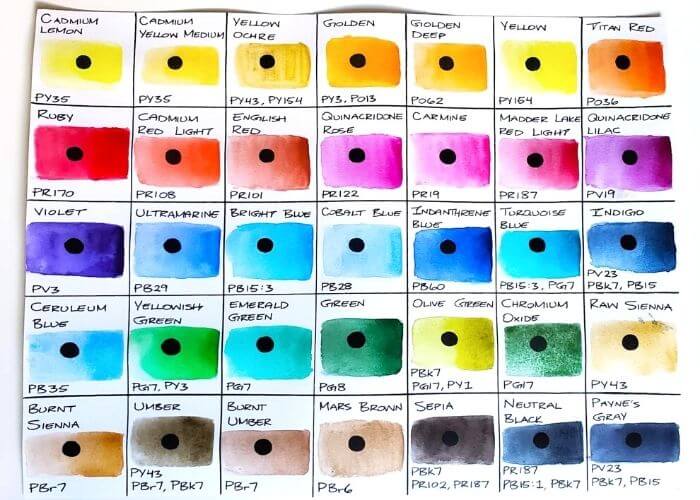
- Understand which paints are labelled as toxic and then label them on a colour swatch chart
Consult the image below to see how I’ve created a colour chart with pigment information for my White Nights Watercolour paints.
Is Watercolour Paint Safe for Skin?
By now you’ve learned that ingesting watercolour pigment or drinking dirty pigmented water isn’t good for your body.
But what about external use, such as if you get watercolour paint on your skin?
Watercolour paint is generally safe when it comes into contact with skin. However, if you have sensitive skin or allergies to certain chemical substances, you might experience irritation or rashes. If such is the case, always check the ingredients before purchasing any watercolour paints.
That’s good to know! So don’t worry; watercolour paint isn’t going to give you cancer or kill you.
And once again, use common sense. If an allergic reaction occurs, stop painting right away and wash your hands. Then, consult your doctor.
Lastly, if you are still worried about is watercolour paint toxic, you can purchase watercolour sets from brands like Crayola that specifically make art supplies that are safe and non-toxic for children.
Note: Children’s watercolour sets are packed with fillers that make the watercolour look chalky and opaque. So check out these tips to learn how to make watercolours look good.
These non-toxic watercolours paints are safer and healthier than professional grade watercolour paints which usually contain more chemical compounds and ingredients.
In addition, if you’re wondering “Can watercolour paint be used on skin,” here’s my advice.
Instead of relying on watercolour paint for body art, do your research and purchase non-toxic body paint or face paint that is specifically made for painting on bodies.

Is Watercolour Paint Toxic to Cats and Dogs?
You love your fur babies, right?
So you want to make sure that they’re as healthy and safe as possible. Therefore, you should take extra precaution around your cat or dog whenever you’re engaged in watercolour painting.
Watercolour paint can be toxic to cats and dogs if the pigments are eaten, licked, or digested. Therefore, you should store your paints in a secure space where your pets cannot reach them. As well, make sure your cat or dog is not near your watercolour supplies or workspace while you’re painting.
To prevent exposure to toxic chemicals, keep your jars of water, mixing palette, and damp brushes away from your pets.
After all, animals are often curious creatures who interact with the world by smelling, touching, and licking objects.
So, be a good owner and keep the welfare of your pets in mind whenever you sit down to paint.
Conclusion
So, is watercolour paint toxic?
The quick and simplified answer is yes and no.
Generally speaking, the majority of watercolour pigments are only mildly toxic. They won’t harm your skin or body unless you have sensitive skin or have an unfortunate allergic reaction to the pigments.
Otherwise, as long as you and your pets don’t ingest watercolour paint internally, you’ll be absolutely fine painting with watercolours.
When all is said and done, don’t worry too much about toxicology in watercolour paints unless you are allergic to specific chemical compounds.
In such cases, please do your research to make sure that the paints you invest in are nonallergenic, safe and as non-toxic as possible.
Now that you’re armed with this knowledge, use this information the next time you decide to buy new watercolour paints.

Miranda Balogh
Artist & Online Educator




Thanks for sharing this information. I have to confess that I´ve never listened about this before. 🙂
Thank you! I’m glad this article has helped you learn something new.
very informative. 😊 Great content for people who loves traditional painting ✨
Thank you for your lovely comment!
This is very helpful, especially if you have kids. Thanks!
The health of your children is very important even when it comes to art supplies and products. So I’m glad this article was able to help you!
It’s good to know that most are not harmful also a good tip about not eating while painting.
Agreed! Most watercolours paints are non-toxic, which is good news for artists!
This is a new topic for me! I appreciate learning more about color toxicity.
I’m glad you were introduced to this topic because it’s something to take note of when you buy new watercolour paints.
Other than not drinking dirty paint water, I would have not really thought much about letting my kids play with watercolour paint. Of course, they wash their hands when they are done or before they eat, but they could rub their nose or scratch their face with the paint on their hands. This is good information for helping raise awareness for parents.
It’s good to know that this article can be a good resource for educating parents who have children that paint with watercolours!
I guess I have to make sure that I wash my hands before eating when I’m painting. I don’t think I could paint with gloves and I’m definitely not staying away from the bright, warm colours! LOL
Thanks for the very useful post.
I won’t be staying away from bright warm colours either! As long as you wash the paint off your hands and don’t ingest the paint, you’ll more than likely be fine.
Do your White Nights watercolours stink? I’ve got 80 colours and everytime I open them they’ve got an unpleasant odour. I wonder why no one is talking about this. None of the other brands that I have (Schmincke, Daniel Smith, Senellier, Winsor & Newton) smell like that.
Hi Emilia! I have the set of 36 White Nights watercolours and none of mine have a bad smell. So, I’m not sure why your set has an unpleasant odour. Maybe you should contact White Nights to see if they can help you out?